One homework-free evening
Sort a supplied packet about practice, workload, family schedules, and completion. Draft only if both the proposal and its strongest objection have relevant support.
PROMPT GUIDES · 2026-10-07
This page does not check whether a citation is real; it assumes a teacher-provided evidence packet and asks a different question: which items support the claim, which support the counterclaim, which are unrelated, and what is still missing? If either side has no usable support, stop at the plan and collect better material before drafting.
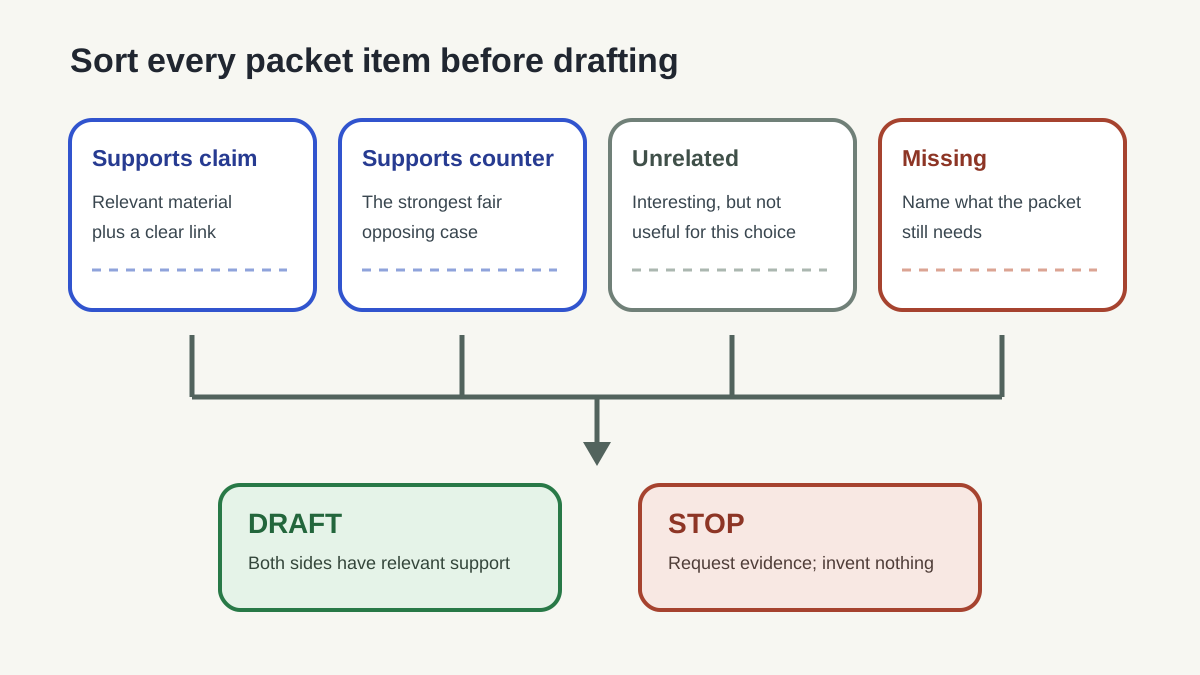
Create an eighth-grade argument task about [TOPIC] using a teacher-provided evidence packet. Before drafting, require the student to place every packet item in one of four bins: supports the claim, supports the counterclaim, unrelated, or missing evidence. For each used item, require one sentence explaining how it connects to that side. If the claim or counterclaim bin has no relevant support, stop and list what evidence is needed; do not invent facts and do not write the essay. When both sides are supported, return a claim, a fair counterclaim, an evidence plan, and a rebuttal plan. Do not write the student's final response.
Try it in the prompt generator →
The source-backed guide asks whether an external factual claim has a traceable source. This page begins later in the workflow: a teacher has already supplied the packet, and the student must decide what argumentative job each item can perform. A real source can still be irrelevant to the claim. A relevant item can still support the other side. A packet can also be genuine yet incomplete.
| Question | Source-backed guide | This grade 8 page |
|---|---|---|
| What is being checked? | Whether a factual claim maps to an accessible source | Whether supplied material supports the claim, supports the counterclaim, is unrelated, or leaves a gap |
| What triggers a stop? | A factual claim has no usable source | One side of the planned argument has no relevant support |
| What comes next? | Verify, label unverified, or remove the claim | Build the two-sided plan or request missing material before drafting |
Copy each packet item onto a card or note. Place it by function, not by whether you agree with it. Then explain the connection in one sentence. A topic match is not enough: the item must help prove or challenge a specific reason.
Relevant material that helps establish a reason for the proposed position.
Relevant material that gives the opposing position its strongest fair case.
Interesting material that does not help resolve the actual question.
A fact, comparison, example, or perspective the packet does not yet provide.
Do not move an item into both sides simply to make the chart look balanced. If it cuts both ways, write two different connections and show exactly how each one works.
This is a synthetic practice packet, not a report about a real school. The question is: Should a school protect one homework-free evening each week?
| Packet item | Bin | Connection |
|---|---|---|
| An anonymous student survey says many respondents want one protected evening. | Supports the claim, with a limitation | It shows student preference, but the anonymous sample does not establish effects on learning. |
| A teacher notes that some courses depend on practice between meetings. | Supports the counterclaim | It identifies a possible cost: a blanket rule could interrupt necessary practice. |
| The cafeteria will test a new lunch menu next month. | Unrelated | It does not address homework, learning, scheduling, or student time. |
| No packet item compares learning or completion before and after a protected evening. | Missing | The plan needs evidence about the policy's likely effect, not preference alone. |
The gate stops the essay here. Both positions have something to discuss, but the central effect is still unsupported. The next move is to ask for a comparison, school record, or teacher-provided case study. The next move is not to turn the survey into proof.
Sort a supplied packet about practice, workload, family schedules, and completion. Draft only if both the proposal and its strongest objection have relevant support.
Classify evidence about learning, emergencies, distraction, and accessibility. Mark any item that discusses phones without addressing the proposed rule as unrelated.
Sort the packet by which option each item actually supports. Stop if costs, users, or scheduling appear for only one proposal.
Separate observations that identify the largest problem from opinions about the easiest solution. Request missing measurements before choosing a priority.
Sort evidence about discussion, motivation, access, and teaching time. Build the counterclaim from its strongest supported reason rather than a weak objection.
Classify packet items about learning, grading time, fairness, and deadlines. Do not treat a preference statement as proof of improved learning.
Compare two realistic uses. Require evidence for the benefits and costs of each; list the users whose needs are missing from the packet.
Sort examples, expert explanations, platform rules, and unrelated opinions. Stop if the packet cannot show how the proposed label would work.
Sort each source excerpt by the proposed cause it supports, a competing cause, unrelated background, or evidence still missing from the comparison.
Classify observations by the design they support. Keep measurements that do not distinguish the designs in the unrelated bin for this decision.
Place quotations under two plausible readings. Stop if one interpretation depends only on plot summary and has no specific textual support.
Sort records and testimony by the proposed priorities. Identify neighborhoods or users absent from the packet before recommending a plan.
Separate observations that discriminate between explanations from facts that fit both. Ask for the missing observation that would change the choice.
Sort evidence for the proposed turning point and for an alternate turning point. Keep later outcomes from being mistaken for proof of the original cause.
Teacher discussions repeatedly describe students who can name claim and evidence but struggle to connect them. One practical response is to make the planning visible. Use paper notes, movable digital cards, or a projected chart. Ask the student to defend the placement aloud: This supports this side because… A peer can challenge the placement before anyone drafts.
This scaffold comes from combining the grade-level requirement to distinguish claims from opposing claims with classroom reports that evidence-to-claim connections remain difficult. The community reports are practitioner experience, not proof that one scaffold works for every classroom.
The claim has relevant support, the counterclaim has relevant support, each connection is explained, and unrelated items are excluded.
One side is empty, the packet supplies only preferences, a key comparison is absent, or the planned rebuttal would need an invented fact.
A balanced plan does not require the same number of cards on each side. It requires enough relevant material to present the opposing position fairly and answer it with reasoning. The student may still decide that the evidence favors one side strongly.
The grade-level requirements are based on the Common Core Grade 8 Writing standards, including distinguishing claims from opposing claims, organizing evidence logically, and recognizing irrelevant evidence. The visible-card scaffold is informed by public teacher discussions in r/Teachers and r/ELATeachers. Those discussions describe individual classroom experience and are not universal findings. The evidence packets and prompts on this page are original PromptSprite teaching examples.
Source checking asks whether information is traceable, accurate, and usable. This gate asks what argumentative job an already supplied item can do. A credible item can still be unrelated to the question or useful only to the counterclaim.
No. The counterclaim needs enough relevant support to be presented fairly. Equal card counts do not guarantee equal strength, relevance, or reasoning.
Name the missing evidence and stop before drafting. Ask the teacher for another packet item, narrow the claim, or choose a question the available material can actually answer.
Yes. A teacher can supply short excerpts, observations, quotations, charts, or case notes. The page teaches sorting and planning; it does not require students to browse independently.
Grade-level requirements come from the Common Core State Standards Initiative Grade 8 Writing standards. Public teacher discussions informed the visible-card scaffold and are labeled as practitioner experience. Prompt cards, the synthetic packet, sorting gate, and decision rule are original PromptSprite editorial material; this page is not an official curriculum or assessment.