PROMPT GUIDES · 2026-09-27
How do I generate a story premise without writing the whole story?
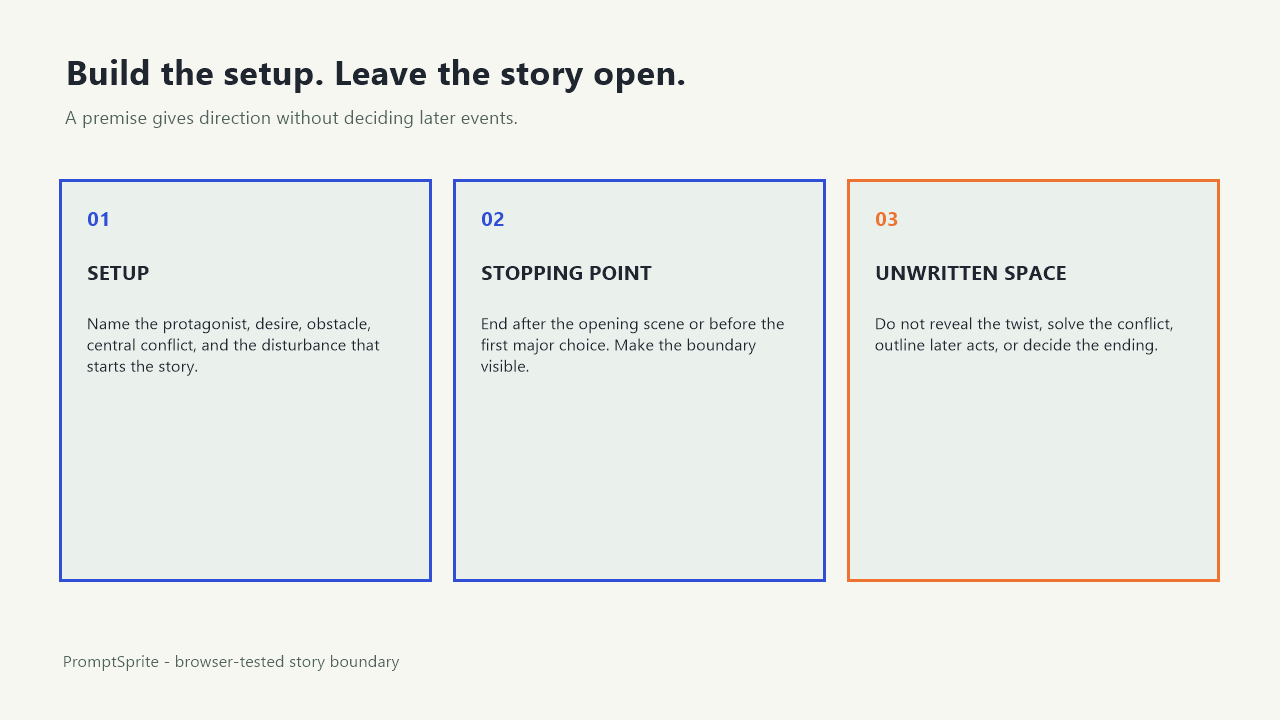
Ask for a story setup, not a finished narrative. Name the pieces you want - premise, protagonist, desire, obstacle, central conflict, and opening scene - then add explicit stopping rules: do not continue past the opening, do not resolve the conflict, and leave the ending to the writer.
Create a story premise from my idea. Return: (1) a one-sentence premise, (2) the protagonist and what they want, (3) the main obstacle, (4) the central conflict, and (5) an opening-scene setup of no more than 120 words. Stop before the protagonist makes the first major decision. Do not outline later acts, solve the mystery, reveal the twist, or write the ending. If a required detail is missing, ask one focused question instead of inventing it.
Try it in the prompt generator →
What Stories mode produced in our browser test
On September 27, 2026, we selected Stories & creative writing and entered: Create a mystery writing prompt about a lighthouse keeper who receives a letter dated tomorrow. Stop after the opening scene and do not write the ending.
PromptSprite returned instructions for a premise, a protagonist, a central conflict, and a starting scene. Its requirements also said to give the protagonist a specific desire and an obstacle, leave room for the writer to decide the ending, and not write the complete story.
That output is a prompt for another tool. PromptSprite did not write the mystery, decide what the letter means, or test whether a downstream model would stop at the boundary. The saved browser record contains the exact input and generated prompt.
Define the deliverable before adding story details
A premise is a compact setup: who faces what situation, what they want, and what stands in the way. A starting scene places that setup in motion. Neither requires a complete sequence of events.
| Include | Hold back |
|---|---|
| One-sentence premise | Act-by-act outline |
| Protagonist, desire, and obstacle | Complete character arc |
| Central conflict | Conflict resolution |
| Opening place, moment, and disturbance | Later scenes and ending |
| A question that pulls the writer forward | The answer to the mystery |
This boundary gives the next tool a concrete product to return. A vague request such as give me a story idea
leaves open whether the response should be one sentence, a synopsis, an outline, or finished prose.
Write stopping rules that can be checked
Do not write too much
is hard to inspect. Replace it with visible limits. Say where the output must stop, which information must remain unknown, and which later-story work belongs to the writer.
- Set a structural stop: end after the opening-scene setup.
- Set a decision stop: stop before the protagonist makes the first major choice.
- Set a revelation stop: do not explain the letter, culprit, twist, or hidden cause.
- Set a resolution stop: do not solve the central conflict or write the ending.
- Set a size limit for the opening, such as 120 words.
Use only the limits that match your task. If you want a three-paragraph opening, do not also request a one-sentence scene. The point is a boundary that a reviewer can recognize in the response.
A lighthouse premise that leaves the story unwritten
Setup components
- Premise: A solitary lighthouse keeper receives a letter in their own handwriting, postmarked tomorrow.
- Desire: Protect the island community without exposing a secret from the keeper's past.
- Obstacle: The warning is incomplete, and the supply boat will not return for three days.
- Central conflict: Trust the impossible warning or follow the normal routine as a storm approaches.
- Opening scene: The keeper finds the dry envelope inside a salt-soaked mailbag and hears the fog bell ring from an empty shore.
These elements create pressure and direction without deciding who sent the letter, what happens tomorrow, whether the warning is true, or how the keeper responds. Those unanswered choices are working space for the writer.
A generated response crosses the boundary if it reveals the sender, maps later events, resolves the storm, or concludes the keeper's choice. Remove those details and keep the setup.
Review the response before you start writing
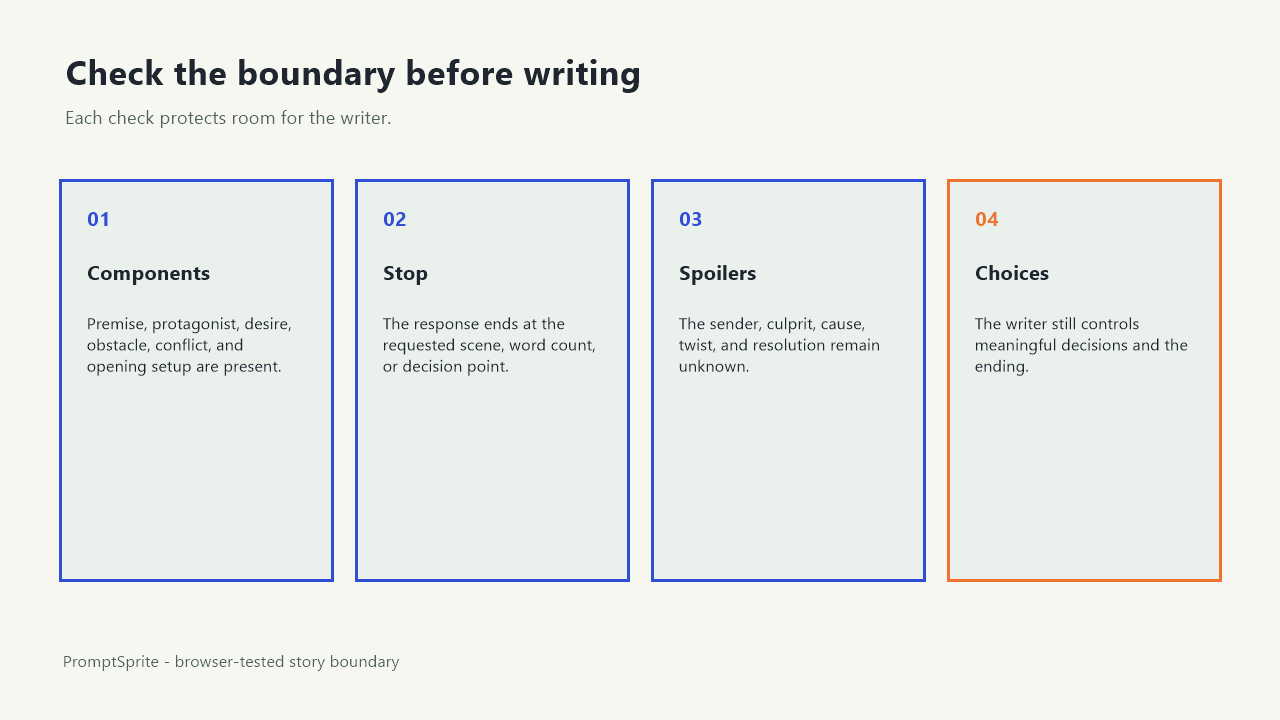
- Deliverable check: Does the response contain the requested premise, character desire, obstacle, conflict, and opening setup?
- Boundary check: Does it stop at the stated scene or decision point?
- Spoiler check: Does it reveal an answer, twist, culprit, or resolution that should remain open?
- Choice check: Are meaningful decisions still available to the writer?
- Fact check: Did the response invent task details you intended to supply yourself?
If the setup is useful but overdeveloped, edit it back rather than asking for more material. Keep the pressure, remove the solution, and rewrite any later event as an open question. The goal is enough structure to begin, not enough plot to remove authorship.
What this test proves and what remains unknown
We verified one PromptSprite Stories-mode run in Chrome. The generated prompt included a premise, protagonist, conflict, starting scene, desire, obstacle, and an explicit instruction not to write the complete story. The worked lighthouse setup and review method on this page are author-written examples.
We did not send the prompt to a model, compare creative quality, or measure how often a model follows stopping rules. Different tools may expand the same request differently. Inspect the actual response and shorten it when it crosses your boundary.
You can inspect the exact browser-test record. Keep your own version of the prompt beside the response so you can check each requested component and each stopping rule.
Questions and answers
Should I ask for an outline when I only want a premise?
Usually no. An outline invites later events. Ask for the setup components and an opening-scene boundary instead.
How do I stop the tool from revealing the twist?
State what must remain unknown, such as the sender, culprit, cause, or ending, and reject any response that reveals it.
Can I request an opening paragraph too?
Yes. Give it a word or paragraph limit and specify the exact moment where it must stop.
Original PromptSprite browser test and author-written story-boundary examples. No downstream model was called, and no creative-quality or compliance rate is claimed.
Watch the walkthrough
Original diagram walkthrough with synthetic English narration. The lighthouse setup is an author-written teaching example, not a model response.