PROMPT GUIDES · 2026-09-29
How do I ask for sources without inviting invented citations?
Require an accessible source for each external factual claim, allow an explicit “unverified” result when no usable source is found, and separate sourced facts from assumptions. Do not demand a fixed number of citations regardless of the evidence. Tell the model never to invent titles, authors, dates, URLs, quotations, or statistics.
Research this question using accessible sources. For every external factual claim, provide the exact source URL and identify what the source supports. Separate verified facts, assumptions, and unresolved questions. If no usable source is available, write “unverified” and omit the claim from the conclusion. Never invent a citation, title, author, publication date, quotation, statistic, or URL.
Try it in the prompt generator →
What our Reasoning-mode browser test verified
On September 29, 2026, we asked PromptSprite to compare two office locations using rent, commute time, and energy costs. The request required an accessible source for every external fact, an unverified
label when a source was unavailable, and no invented citations.
The generated prompt preserved all three requirements. It also added rules to separate verified facts from assumptions, check calculations and units, cite accessible sources for external facts, and state limitations. The output format was a table.
This was a prompt-construction test. It did not browse the web, retrieve a document, compare offices, validate a citation, or call a downstream model.
Use a claim-to-source contract
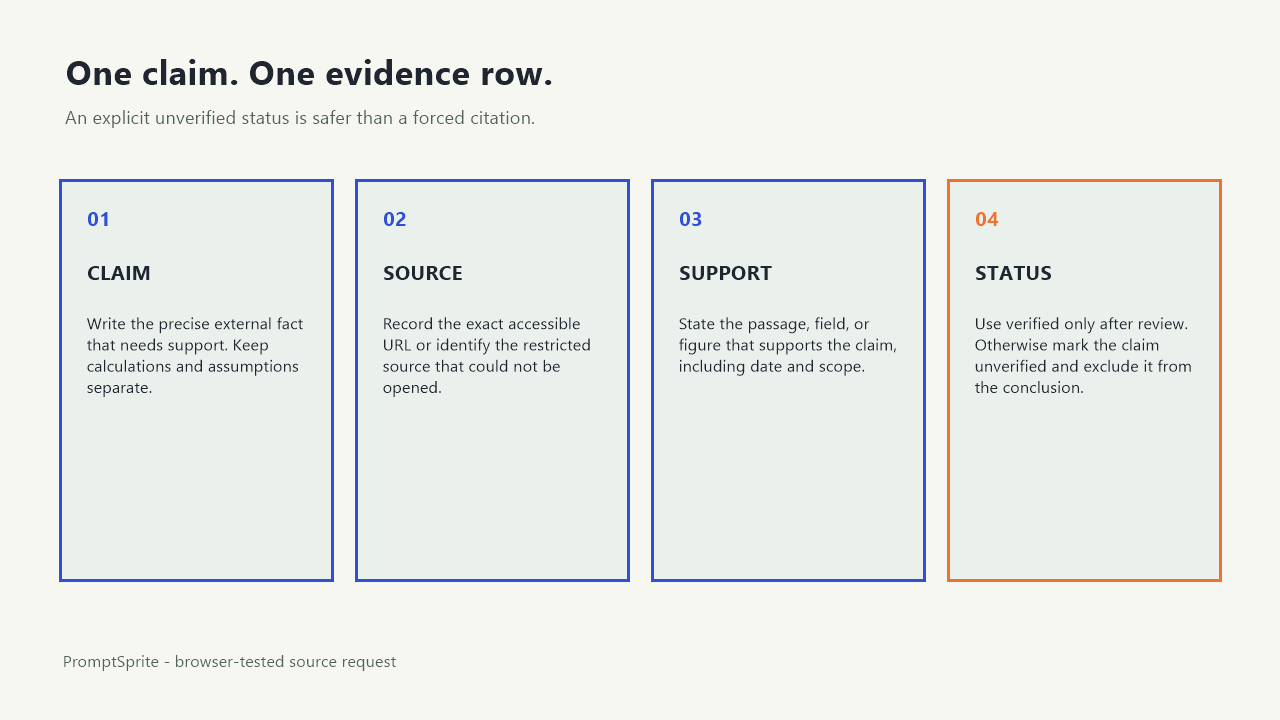
A source request is easier to audit when each claim has its own evidence row. Ask for this structure before asking for prose:
| Claim | Exact source URL | What the source supports | Status |
|---|---|---|---|
| Rent for location A | Required | Amount, unit, period, and property | Verified or unverified |
| Commute time | Required | Route, mode, departure time, and date checked | Verified or unverified |
| Energy cost | Required | Tariff or bill, usage period, and calculation inputs | Verified or unverified |
The support column prevents citation laundering: attaching a real URL that does not support the sentence. The status column gives the model a permitted outcome when evidence is missing.
Four rules for a safer source request
- Require access: ask for a URL that the reader can open, or name the restricted source and mark it unavailable.
- Map evidence to claims: state exactly which words, field, or figure each source supports.
- Allow uncertainty: use
unverified
rather than forcing a citation for every row. - Forbid fabricated metadata: prohibit invented authors, titles, dates, quotations, statistics, and URLs.
A fixed citation count can reward padding. Ask for the evidence needed by the actual claims instead. A short answer with two relevant sources can be more useful than a longer answer with five loosely related links.
Build the office comparison from an evidence ledger
Start with the decision fields and leave values blank until evidence is supplied or found. This author-written example contains no real office data:
| Decision field | Evidence needed | Calculation | Current status |
|---|---|---|---|
| Monthly rent | Lease quote or listing for the exact unit | Quoted amount plus stated recurring charges | Unverified |
| Typical commute | Route result with mode, origin, destination, time, and date | Minutes per trip × expected trips | Unverified |
| Energy cost | Recent bill or published tariff plus expected usage | Usage × applicable rate, with fees listed separately | Unverified |
Do not rank the locations yet. First collect comparable evidence, normalize periods and units, and record assumptions beside the calculation. If one row remains unverified, keep it out of any numerical total or label the total incomplete.
Review each citation before trusting the conclusion
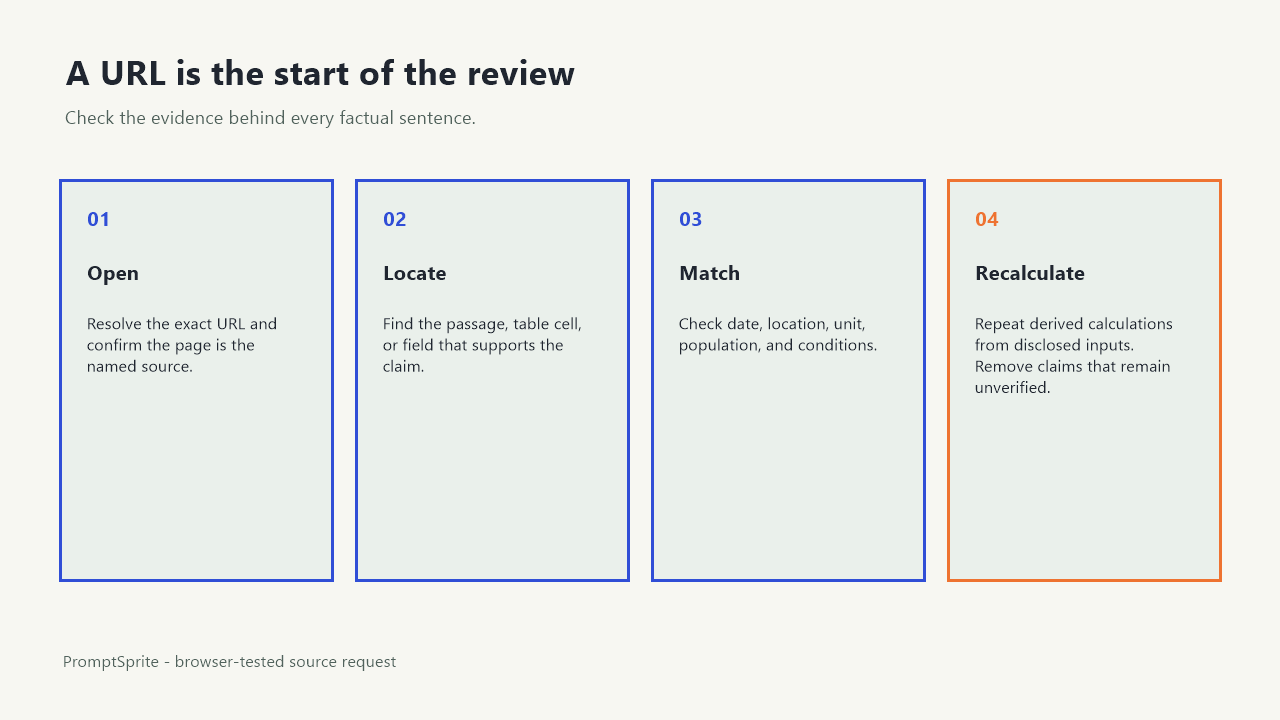
- Open the exact URL and confirm it resolves to the named source.
- Find the passage, table cell, or field that supports the claim.
- Check the publication or update date and the period covered by the data.
- Check scope: location, product, unit, population, and conditions must match the claim.
- Recalculate derived numbers from the disclosed inputs.
- Remove a claim from the conclusion when its evidence cannot be verified.
A correct citation is not proof that every nearby sentence is correct. Review the claim-to-source mapping one row at a time.
What this test proves and what remains unknown
We verified one public PromptSprite Reasoning-mode run in Chrome. The generated text preserved the user's source rules and added separate requirements for verified facts, assumptions, calculations, citations, and limitations.
We did not test a research agent, a search provider, source availability, citation accuracy, or the final office comparison. Those depend on the downstream system and the evidence it can access. A well-formed prompt makes unsupported claims easier to detect; it cannot guarantee that another system follows the instructions.
You can inspect the exact browser-test record. It contains the input, settings, output, observed strings, and test limitation.
Questions and answers
Should I require a minimum number of sources?
Usually no. Require a relevant accessible source for each external claim and let the evidence determine the count.
What should the answer say when no usable source exists?
Mark the claim unverified, explain what evidence is missing, and keep it out of the conclusion.
Does this prompt guarantee accurate citations?
No. It creates an auditable structure, but each URL and claim still needs to be opened and checked.
Original PromptSprite browser test and author-written evidence-ledger example. No sources were retrieved and no citation-accuracy claim is made.
Watch the walkthrough
Original evidence-ledger walkthrough with synthetic English narration. No external facts or citations are asserted.